How Long Does It Take to Recover from a Rotator Cuff Tear Without Surgery?
If you've been diagnosed with a rotator cuff tear, your first question is probably the same as everyone else's: do I need surgery?And if the answer is no, which it often is, the next question is: how long rotator cuff tear take to recover without surgery?
The honest answer is that it depends. Recovery from a rotator cuff tear without surgery ranges from a few weeks to over a year, depending on the severity of the tear, your age, activity level, and — most importantly — whether you get the right treatment early.
This guide breaks down what you can realistically expect, and how physiotherapy at our Millwoods and Edmonton clinics can help you recover faster and more completely.
What Is a Rotator Cuff Tear?
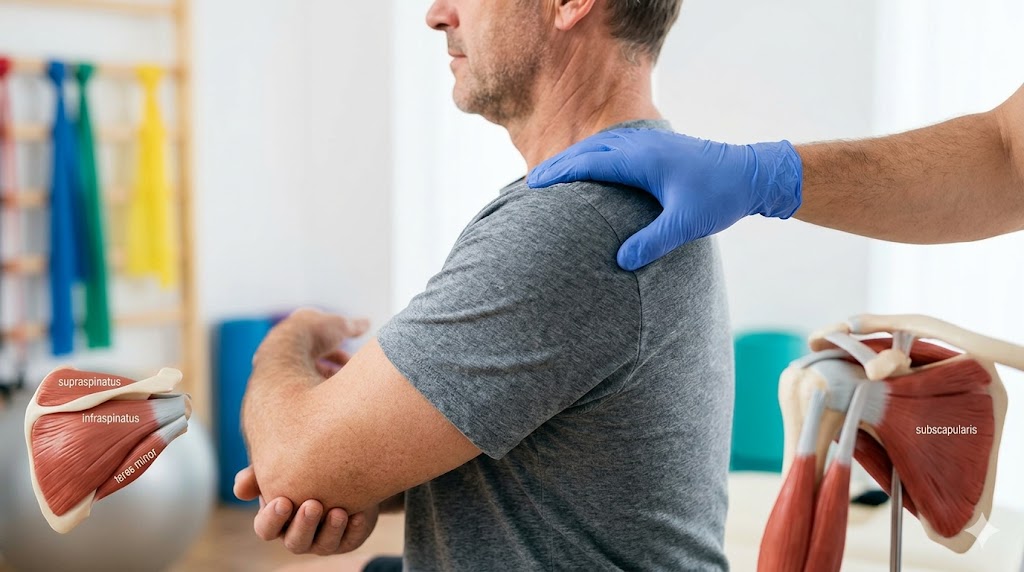
The rotator cuff is a group of four muscles and their tendons that surround the shoulder joint, keeping the head of your upper arm bone seated firmly in the shoulder socket. These muscles control almost every movement your shoulder makes — reaching overhead, lifting, rotating your arm, and throwing.
A rotator cuff tear happens when one or more of these tendons partially or fully detaches from the bone. Tears fall into two main categories:
- Partial tears — the tendon is damaged but not completely severed. These are the most common and most treatable without surgery.
- Full-thickness (complete) tears — the tendon is torn all the way through. Some full-thickness tears can still heal conservatively; others may eventually require surgical repair.
Can a Rotator Cuff Tear Heal Without Surgery?
Yes — many rotator cuff tears, including some full-thickness tears, can heal or be managed successfully without surgery. Research consistently shows that physiotherapy produces outcomes comparable to surgery for most partial tears and even for a significant portion of complete tears, particularly in people over 60 whose activity demands are lower.
Surgery is generally considered when:
- The tear is large and the patient is young and highly active
- Conservative treatment (physiotherapy, rest, anti-inflammatories) has failed after 3–6 months
- The shoulder has become severely weak or unstable
- The tear was caused by a sudden traumatic event
For the majority of rotator cuff injuries seen in a physiotherapy clinic, non-surgical treatment is the first and often the only step needed.
Rotator Cuff Tear Recovery Timeline: What to Expect
Here is a general guide to what recovery looks like when managed conservatively with physiotherapy.
Weeks 1–4: Acute Phase (Pain Management and Protection)
The first priority is calming the inflammation and protecting the shoulder from further damage. This is not the time to push through pain.
During this phase your physiotherapist will focus on:
- Reducing pain and swelling with manual therapy and gentle movement
- Teaching you which positions and activities to avoid
- Beginning very gentle range-of-motion exercises (pendulum exercises, assisted range of motion)
- Addressing any muscle guarding or compensatory patterns
Most patients notice a meaningful reduction in pain within the first 2–4 weeks with consistent treatment.
Weeks 4–12: Rebuilding Strength and Mobility
Once acute pain is under control, the focus shifts to restoring range of motion and beginning a targeted strengthening program. This phase is critical — moving too fast leads to re-injury, and moving too slowly leads to stiffness and muscle wasting.
Treatment during this phase typically includes:
- Progressive rotator cuff strengthening exercises
- Scapular stabilization work (the shoulder blade muscles play a huge supporting role)
- Manual therapy and soft-tissue mobilization to release tight structures
- IMS (dry needling) if trigger points are contributing to pain and weakness
- Shockwave therapy for chronic or stubborn tendon pathology
Months 3–6: Return to Full Function
For partial tears and minor full-thickness tears, most patients can return to their regular activities by months 3–6 with consistent physiotherapy. Overhead athletes and people doing physically demanding work may take closer to 6 months to return at full capacity.
Goals during this phase:
- Restoring full strength to match the uninjured side
- Rebuilding confidence and normal movement patterns
- Sport-specific or work-specific rehabilitation
Months 6–12: Large or Complex Tears
Larger tears, significant tendon degeneration, or cases where treatment started late may take up to 12 months for full recovery. Progress during this period is often slower and more non-linear — some weeks feel better than others.
If you are not making progress by months 3–4 despite consistent physiotherapy, your physiotherapist may recommend imaging (MRI or ultrasound) or a surgical consult to reassess the tear.
Factors That Affect How Long Recovery Takes
Recovery is not one-size-fits-all. These factors have a significant impact on how quickly you heal:
Tear size and type. A small partial tear in a healthy tendon heals far faster than a large full-thickness tear with significant retraction.
Age. Tendons in older adults have reduced blood supply and slower cellular repair. This does not mean older adults cannot recover — they absolutely can — but timelines tend to be longer.
How long the tear has been present. Chronic tears that have been irritated for months before getting treatment are harder to rehabilitate than acute injuries caught early.
Your activity level and compliance with rehab. Physiotherapy only works if you do the exercises. Patients who follow their home exercise program consistently recover significantly faster.
Smoking and general health. Smoking reduces blood flow to tendons and slows healing. Conditions like diabetes also affect tissue repair.
Whether you received the right treatment early. This is the single biggest controllable factor. Starting with a skilled physiotherapist who accurately diagnoses the tear and builds a targeted program makes an enormous difference to outcomes.
How Physiotherapy at Millwoods Physio Helps
At our Millwoods and Edmonton clinics, we treat rotator cuff tears with a structured, personalized approach. No two shoulders are the same, and your program will be tailored to your specific tear, your goals, and your body.
Depending on your presentation, your treatment may include:
- Manual therapy and joint mobilization to restore normal shoulder mechanics
- Soft-tissue mobilization and myofascial release to address muscle tightness and scar tissue
- IMS / dry needling to reduce pain from trigger points in the rotator cuff and surrounding muscles
- Shockwave therapy for chronic tendon degeneration that hasn't responded to other treatment
- Graston Technique to break down fibrous tissue and improve tendon healing
- Progressive strengthening programs designed to restore strength without re-aggravating the tear
We also direct-bill most major Alberta insurance plans, and we're open 7 days a week — so getting started is as easy as it can be.
When to Seek Help
Don't wait and see if your shoulder heals on its own. Rotator cuff tears — especially partial tears — respond best to early intervention. Leaving a tear untreated often leads to progressive weakness, compensatory muscle patterns, and in some cases, a tear that grows larger over time.
If you have shoulder pain that:
- Has persisted for more than 2–3 weeks
- Is worse at night or when lying on that shoulder
- Makes it difficult to lift your arm above shoulder height
- Came on after a fall, a heavy lift, or a throwing motion
...it is worth getting assessed. A physiotherapist can evaluate your shoulder, determine the likely cause of your symptoms, and get you started on a recovery plan the same day.
Book a Shoulder Assessment at Millwoods Physio
Our team at Millwoods Physical Therapy Centre has helped hundreds of Edmontonians recover from rotator cuff injuries without surgery. Whether you've just been diagnosed or have been dealing with shoulder pain for months, we can help you understand your options and get moving again.
Call us at (780) 440-9003 or book online at millwoodsphysio.janeapp.com — we're open 7 days a week at our Millwoods, Creekwood, and Glenridding locations.